

Spin bikes are one of the best workouts you can get on a cardio machine. They’re great for high-intensity endurance training, weight loss, and even physical therapy. But with so many choices it’s hard to know where to start.
How do you know which ones are good or bad? What should I consider before buying? Any brands that I should be avoiding? What’s the industry standard for warranty?
I made this review to help remove some of the guesswork that’s often involved when shopping for cardio equipment .
- Best chain-driven spin bike: Schwinn IC Pro
- Best belt-driven spin bike (with monitor): Peloton Bike
- Runner up belt-driven spin bike: Keiser M3i
- Best budget spin bike: ProGear 100S
Other Solid Picks:
- Sunny Health & Fitness SF-B1002C
- Sunny Health & Fitness SF-B1002
- Sunny Health & Fitness SF-B901
- Sunny Health & Fitness SF-B1423C
- Exerpeutic LX7
- Sunny Health & Fitness SF-B1110

Article Contents
Spin Bike vs. Upright Bike: What’s The Difference?
Spin bikes have a weighted flywheel that’s directly linked to the transmission. Their braking system is generally direct contact (not frictionless) and rides just like a road bike. Upright bikes ride like a regular bike.
Spin bikes are normally reserved for sprint interval training where you stand and pedal over long, grueling workouts.
Upright bikes often come with a built-in console and heart rate monitors. The resistance is controlled digitally through the display whereas it’s manual on spin bikes.
Spin bike pros:
- Low impact
- Designed for HIIT (stand and pedal)
- Great for rehab, weight loss, and improving leg strength
Spin bike cons:
- Not suitable for children
- Doesn’t work upper body
- Can be strenuous on your back
- Lots of them use a micro-tension know and don’t have preset resistances (harder to measure progress)
What to Look for in a Spin Bike
Steel frame: Most spin bikes are steel, the heavier the frame/bike, the sturdier the ride. Important when sprinting or doing HIIT.
Multi-grid handlebars: Different intensities call for different grip points. Make sure your spin bike can accommodate all of the different grip points.
Hybrid pedals: Also known as combo pedals, these have toe cages to accommodate regular shoes or clips for biking specific shoes.
Display: Surprisingly, a nice spin bike display is hard to come by, but they make data tracking, headphone syncing, and goal tracking a lot easier. If you’re like me and always need to see total distance, you’ll appreciate a screen that is always displaying it without having to press a button to get to it.
Media tray: Meant for your iPad/tablet/book/magazine and makes multitasking much easier.
Design: A sleek, contemporary design will give you the freedom to leave your spin bike out in the open without having to worry about making a bad impression on your visitors.
Interchangeable seat and pedals: If you have multiple people riding the bike, who have different shoes and foot sizes, you’ll want highly adjustable and an interchangeable seat and pedals.
Adjustability: Some bike seat/handlebars have 2-way adjustability (forward/backward), others have 4-way adjustability (forward/backward/up/down). This is especially important for spin bikes at home being used by the entire family.
Bluetooth: Makes everything easier. Things like syncing your bike to an app and projecting your workout onto a screen. Or syncing your phone to the bike for easy data dumping. Don’t have to worry about cords.
Warranty: Good quality spin bikes can take a beating multiple times a day and last for years. Check the warranty on the bike frame, good quality bikes will have a lifetime warranty.
Inseam: If you’re really short or really tall, take a close look at the inseam measurements on the bike to make sure you’ll fit. Most bikes accommodate anywhere from 5’0″ to 6’4″. The best thing you can do is try before you buy.
Other Things to Keep in Mind
Flywheel
The flywheel is what makes a spin bike and its weight heavily influences the overall price of the bike. Why? The heavier the flywheel, the more momentum you have and the smoother / more stable your ride will be. Ever wonder how spin bikes get their ‘outdoor bike’ feel? That’s right… the flywheel!
Drive system (chain or belt)
Belt drives are a better drive system and always more expensive. They’re extremely smooth and quiet which makes multitasking easier (watching TV, reading, etc.). Plus, they’re cleaner (greasing a chain is messy!), require less maintenance, and usually last longer than chain drives. You’ll find a mix of both when shopping for spin bikes so it’s important to be aware of these differences.
Resistance (direct contact or frictionless)
Most spin bikes are direct contact and use calipers or pads to apply resistance to the flywheel. There are no preset resistance levels with direct contact systems, just tighten the knob until it feels good. Sometimes, less quality bikes, have VERY sensitive knobs and you’ll go from easy to impossible with a slight adjustment.
Magnetic resistance (frictionless) spin bikes are always more expensive because they’re smoother, quieter, and require less maintenance (no oil/lube needed). Plus, you don’t have to worry about replacing the pads and they usually come attached to a screen with preset resistances making it easier to follow along in spin classes and track your progress.
Customer service & return policy
Do some research on the customer service because even great products act up sometimes. Great customer service can be the difference between a slight headache and a migraine.
Make sure to familiarize yourself with the warranty and return policy beforehand. There are hundreds of brands each with nuanced warranty rules. Knowledge is power!
Assembly
Shouldn’t take you much longer than an hour to setup your new bike. Difficult and confusing assembly is often a reflection of the quality of the bike, make sure to do your research.
Best Spin Bikes: Reviews & Recommendations
Best chain-driven spin bike (no monitor):
Schwinn IC Pro
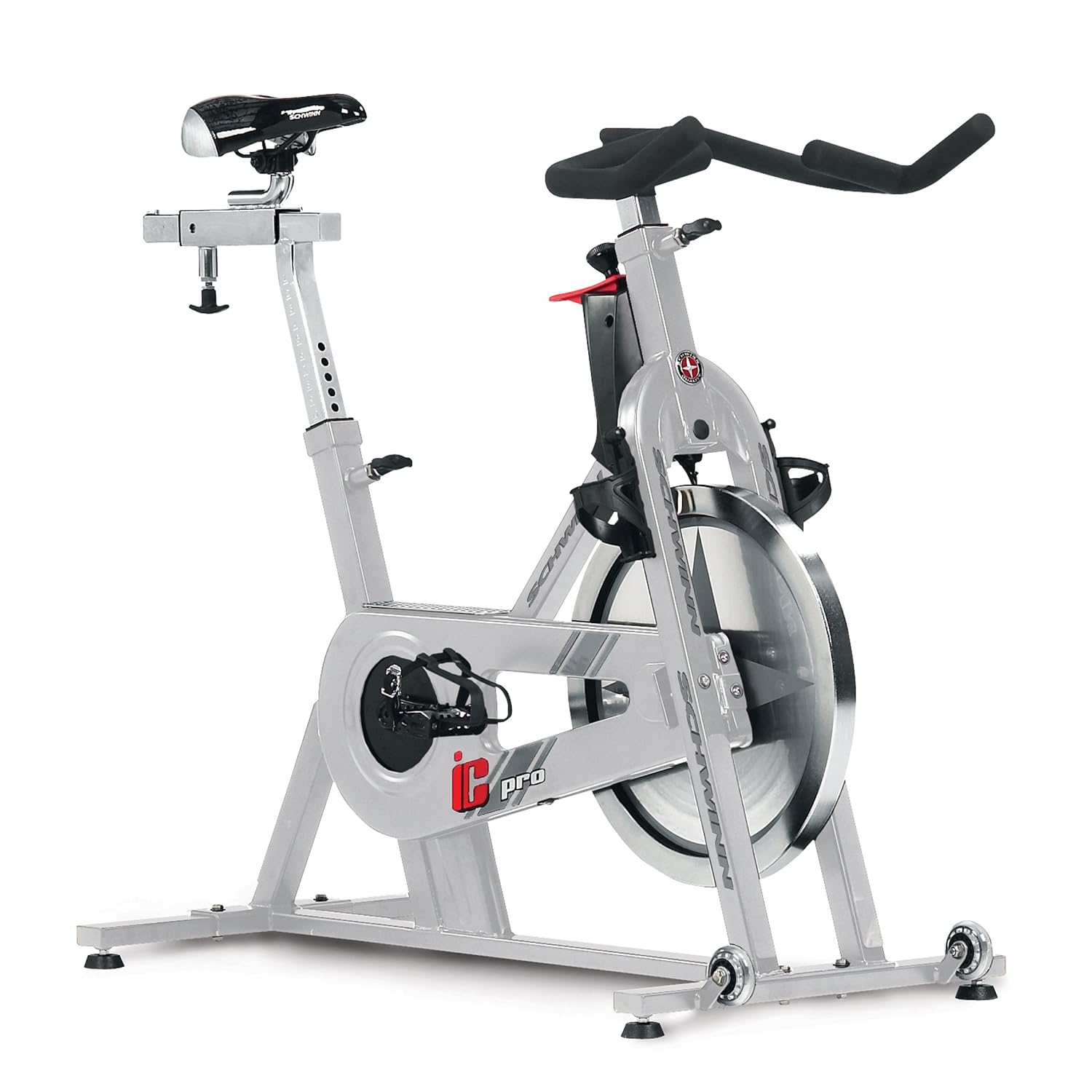
I’m a taller guy, about 6’3, which can make finding a comfortable exercise bike a bit tricky at times. The IC Pro is highly adjustable and accommodates a variety of sizes, from 4’11” to 6’8″, which covers 90% of us.
The other big differentiator is the 10-year warranty on the frame. Most spin bikes have a 1-year warranty and the odd ones have 3. That alone says a lot about the build quality of this bike which is why I’m happy to recommend it.
Other than that, it’s pretty similar to its competitors. It has a steel frame, multi-grid handlebars to accommodate all four grip types, a knob to adjust resistance (no preset levels), transport wheels to make it easy to move around, and a water bottle holder.
Who’s it for?
The IC Pro is made for advanced ‘spinners’. If you want a top-of-the-line product, prefer chain driven over belt driven, and don’t wanna spend any more than this, it’s a great choice.
Best belt-driven spin bike (with monitor):
Peloton Bike
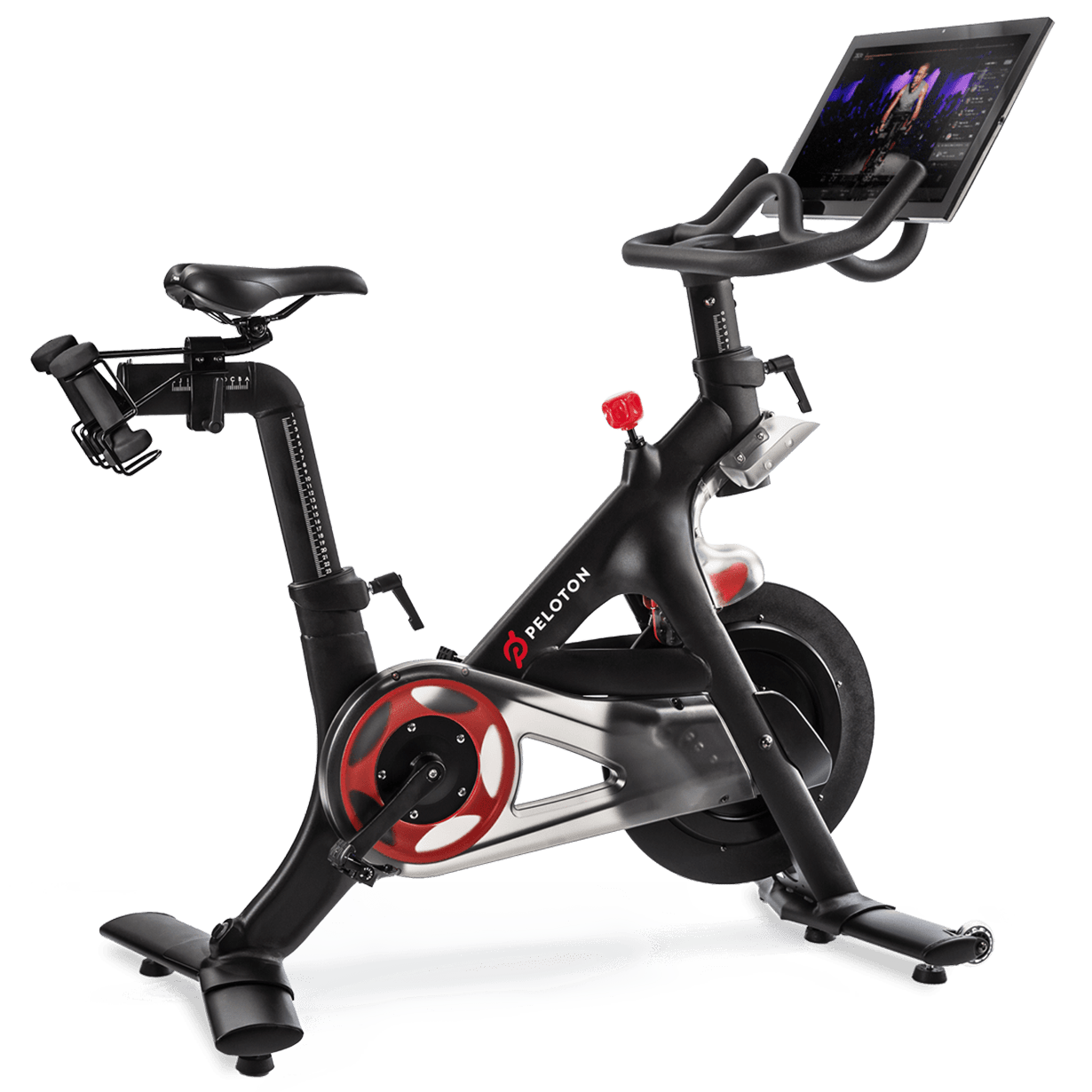
You even get to choose the instructor which is great if you have a preferred style of trainer. And you get to choose the music playlists to keep you motivated. They offer off bike workouts as well which will allow you to work your upper body.
Who’s it for?
The Peloton is for people who love spin class, but hate the commute and membership fees, and want to simulate the experience at home. Also, if you get bored easily on cardio machines, you won’t on this one.
What else?
Weighs 149 lbs, comes with a 30-day guarantee, Bluetooth, supports up to 300 lbs, accommodates a variety of body types (4’11” to 6’5″).
Runner up belt-driven spin bike:
Keiser M3i
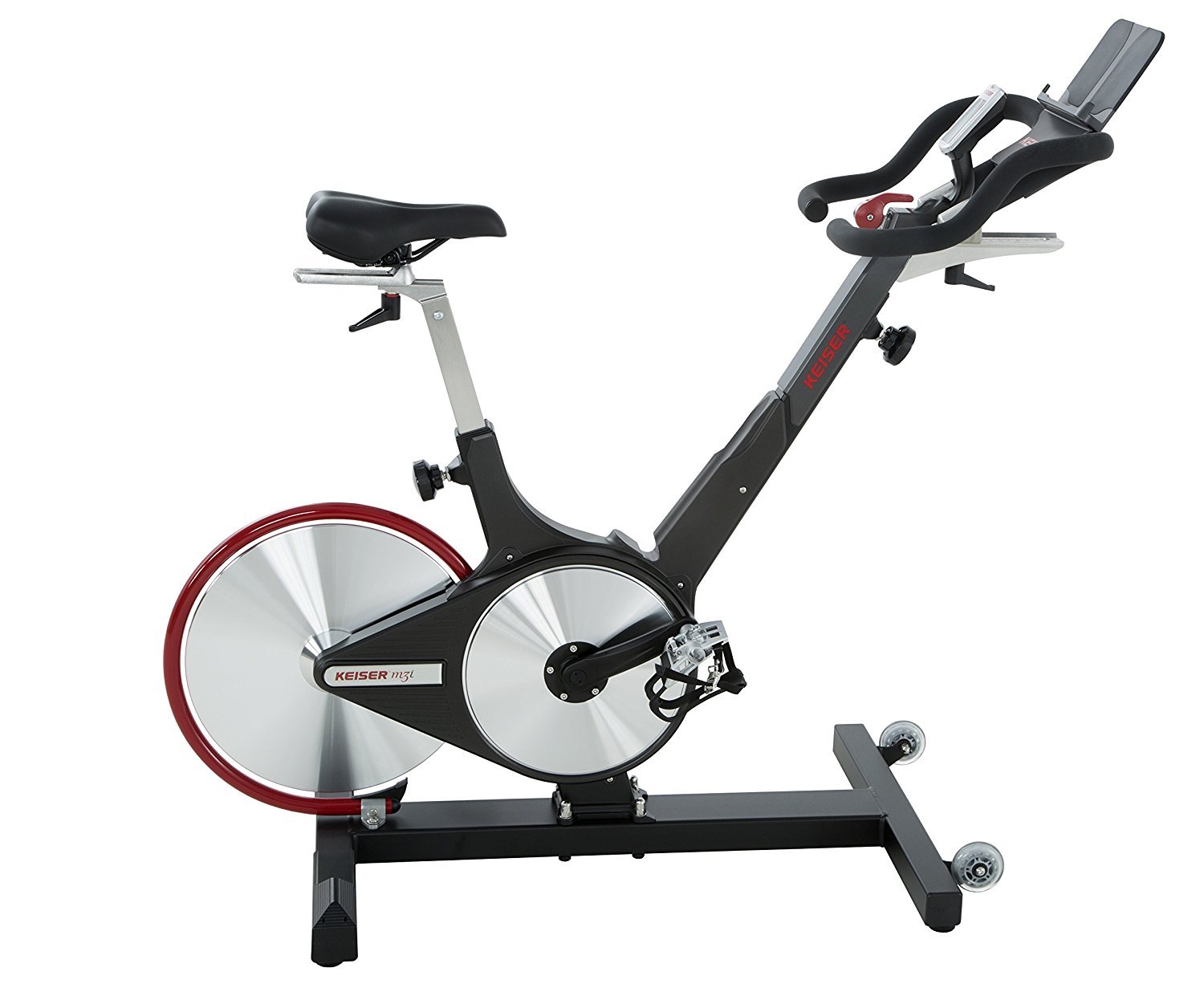
The M3i doesn’t come with a monitor at all (which is the biggest difference) which means you’ll save some money in the long run because you’re not having to pay a $39/mo fee. But it does come with Bluetooth which can be used to project your workout onto a screen or easy syncing to a smartphone or tablet.
But it does come with magnetic resistance which means little to no maintenance and no replacing brake pads. All you have to do is wipe it down with a damp cloth every once in awhile and you’ll be fine.
It’s arguably nicer looking than the Peloton which means you can keep it out in the open without feeling ashamed when you have visitors. The seat/handlebars are highly adjustable which is great if you have multiple people using the bike at home. And it supports up to 300 lbs.
Drawbacks? It doesn’t have preset workouts, only syncs with Keiser specific apps and Polar chest straps, and not all of the required assembly tools come with it (see full list of tools on page 4 here ).
Best budget spin bike:
ProGear 100S
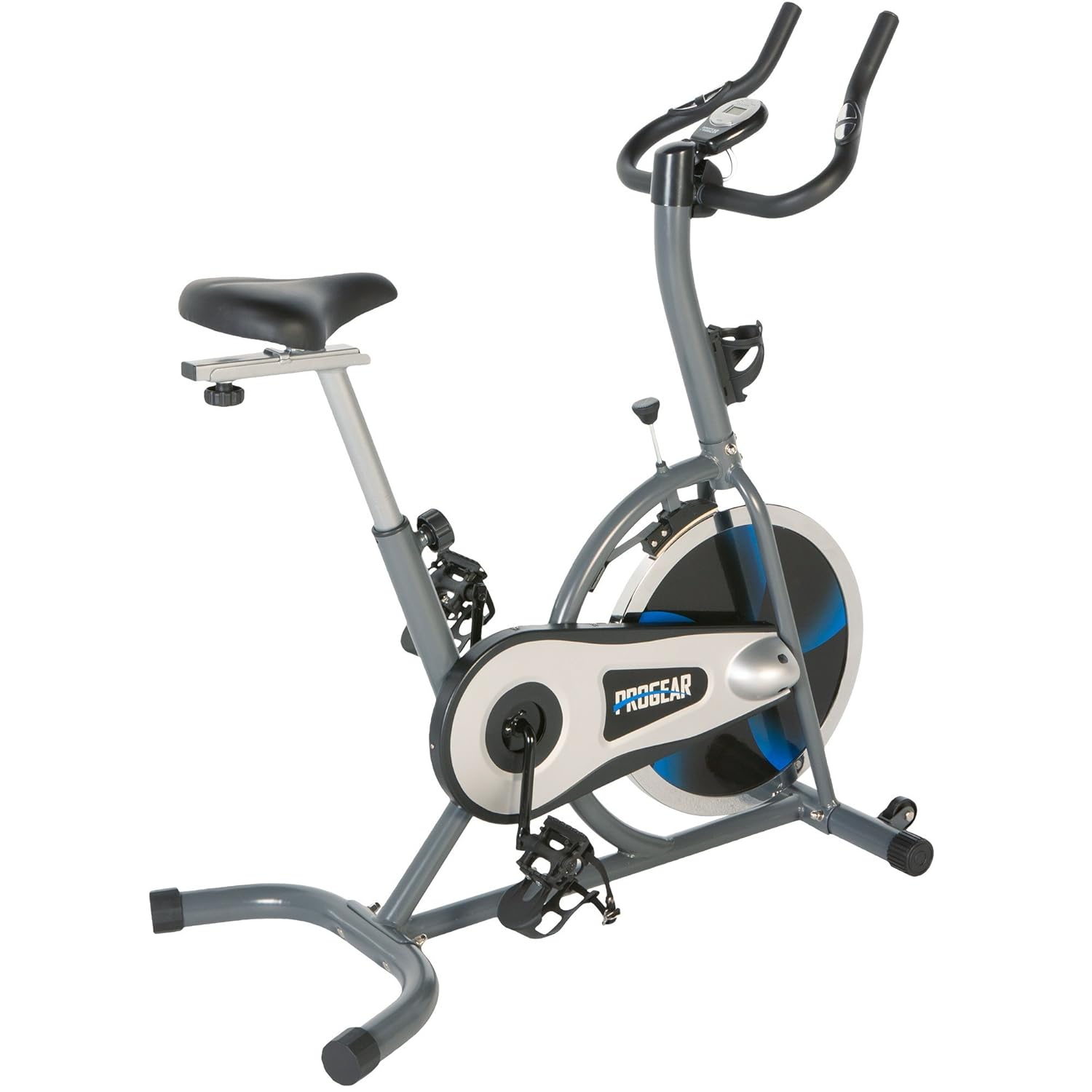
It comes with heart pulse sensors which will help you stay in the fat burning zone and lose more weight. It fits a variety of body sizes — from 5’1″ to 6’2″ — with its 4-way seat adjustability.
The screen is really basic but most spin bike displays are (if they have one at all). And it’s a chain driven system which isn’t as good as belt drives but again, lots of spin bikes are chain driven.
Other Solid Picks
Sunny Health & Fitness SF-B1002C (chain): Much more affordable than the IC Pro without losing too much. The flywheel is quite heavy at 49 lbs and the overall weight is 115 lbs. Supports up to 275 lbs. Drawbacks? No display.
Sunny Health & Fitness SF-B1002 (belt): Same specs as the SF-B1002C, only difference is the belt-driven system. Great budget option for a belt-driven bike. 3-year warranty on frame, 4-way adjustable seat.
Sunny Health & Fitness SF-B901 (chain): Given the price point, this would be a better used option. For not much more you can get a much heavier bike/flywheel with the SF-B1002C. Drawbacks? Only 2-way adjustable handlebars.
Sunny Health & Fitness SF-B1423C (chain): Same thing here, better used option. You can spend a few bucks more and get a much heavier/sturdier bike. Wouldn’t recommend buying new unless you’re doing it for the display.
Exerpeutic LX7 Indoor Cycle Trainer (chain): If you would rather have a basic display than no display at all, and don’t mind sacrificing a heavier flywheel, this is a great choice. Otherwise, you can get the SF-B1110 for a few dollars more.
Sunny Health & Fitness SF-B1110 (chain): Good used option. Similar to the SF-B901 but a few bucks cheaper because the frame isn’t solid steel, it has some plastic. If you weigh less than 250 lbs, don’t mind the lighter/plastic frame, and want to save a few bucks, this is a solid pick.
Spin bikes are one of the best cardio machines to buy for your home. Not only will they spare you the commute to and from the gym, and help you save on pricey membership fees, they’re also great for weight loss, improving leg strength, and rehabbing injured joints.
If you’re looking for a top-of-the-line product and aren’t too concerned with cost, your best bet is the Peloton Bike . Otherwise, you can soften the blow to your wallet and go with any of the alternative options listed above.
Sources
What is the practical difference between a spinning and ‘regular’ stationary exercise bike?

